


Search Results for 'script'
Tap Forms Database Pro for Mac, iPhone, iPad and Apple Watch › Forums › Search › Search Results for 'script'
-
AuthorSearch Results
-
November 11, 2019 at 3:46 AM #38003
In reply to: Script to calculate percentage of ticked rows
Roy McKee
ParticipantMy mistake, Sam, I had inadvertently entered the wrong field ID. Sorry about that. I confirm the script is working fine. Thank you very much for your help, much appreciated.
November 10, 2019 at 9:09 PM #37999In reply to: Database Corruption
Sam Moffatt
ParticipantDo you mind expanding on what might have happened with the sync incident? Can you also share how you have your sync setup? Were you using P2P sync? Were all devices added to each other? Was one device offline for an extended period of time?
For the Mac, do you have Time Machine set up and can you restore a copy of your document from a time before you noticed the sync issues to review it’s state?
1. A difference in record count is a relatively good thing, it means you might be able to pull changes out of each of the devices.
2. The attachments might have failed to sync properly and changes on one device have overwritten changes on another device. This is a part of the sync resolution system where the most recent change should win though it seems in this case that something didn’t sync properly.
3. This feels like you’ve not lost image attachments for those records but just find them in the wrong order?
To your questions:
1. *Is there a way to diff missing records?* I don’t know of an easy way to do this, I’ve been working on a set of Terminal tools that might do something like this (and get a more complete backup) however it isn’t user friendly.
2. *Is there a way to sort edited images?* If your image field is only intended to have one image, you might be able to write a script field to count the number of images that are in the field and find the records that need intervention. You might be able to use a script field to examine the photo field and see if there is a pattern to the filenames of the edited images. I’m not sure if you could use
record.setFieldValueto re-order the images within the field but that would be the way forward.On the second one I’d be hesitant to make any changes because if you do when it comes to resolution time, those changes could cause some more damages.
If you are comfortable with a less than polished experience and using the Terminal, I can upload one of the backup tools I have that tries to pull back old revisions of documents from a Tap Forms database. That might be able to find anything that you’re missing.
November 10, 2019 at 12:18 PM #37995In reply to: Script to calculate percentage of ticked rows
ParticipantWhen you run the form script, what value does it show for you? The screenshot was from my form so is obviously going to be different for you and your form. Could you attach a screenshot of what you see? What makes it impossible?
November 10, 2019 at 7:23 AM #37992In reply to: Script to calculate percentage of ticked rows
ParticipantThanks Sam, the script now works although it provides an impossible result. There are currently 44 records (there will be hundreds when I have finished the DB). I am trying to work out the number of Google No 1’s out of the 44 records. There are 32 ticked, which is more like 75%. I see from your result that there were 33%, which was probably accurate at the time you did it. I can only assume something has changed i the script but cant see anything wrong.
This is how I have copied it:
var Google_No_1 = ‘fld-4cbc05636709431a8305cfb7739a9bc5’;
var records = form.getRecords();
var checked = 0;
for (record of records)
{
checked += record.getFieldValue(Google_No_1);
}let percentage = checked / records.length * 100;
Utils.alertWithMessage(‘Calculation Result’, percentage);
percentage;November 10, 2019 at 2:06 AM #37981In reply to: Exporting to text file
Brendan
KeymasterThe Script engine doesn’t support reading or writing directly to files in the file system. It can only write to records.
You could export as a CSV file perhaps. I know that vCard files can contain multiple vCards within the same file. Maybe if the data was structured properly enough then you could achieve this.
November 10, 2019 at 1:26 AM #37978In reply to: Calling a script with an AppleScript
ParticipantIt’s a little different for sure, it’s an attempt to bypass the MacOS restrictions though I guess it’s not working for you. In any case the next version will fix the record selection quirk so that means calling into Tap Forms will work for your use case. Apple keep locking things down which makes some of these more advanced scripting features a little harder to implement each year.
November 9, 2019 at 11:38 PM #37977Topic: Exporting to text file
in forum Script TalkEddy
ParticipantHowdy!
Actually I don’t know, id this is a feature request or if I just do not see the way, how to do it right now:
Our task is to export a text file out of a field of a record.
Concrete: I made a script field, that produces the complete code for a Vcard. So, until now, I copy the produced code/text to the clipboard, create a text file on the mac, copy the clipboard’s content into the text file, change the text file’s extention from “.txt” to “.vcf”. Than, finally(!), I can drag that VCARD to the Addressbook.
So, now, I am looking for a way to save the steps in the middle. It would be so great if a could (maybe triggered by a script) force tapforms to export the content of a record’s field to a file and chose the filenames ending/extension directly.
Any ideas?
Thanks in advance,
Eddy
November 9, 2019 at 11:18 PM #37976Topic: Get Picture's File Name
in forum Script TalkParticipantHi Folks!
I need to get access to the file names of stored pictures.
In the form “customers” every customer has a picture on/in his record. In a script i need to get the name of that file.
Using “.getFieldValue” does not help.
Any ideas?
Thanks in advance,
Eddy
November 9, 2019 at 12:23 PM #37964In reply to: Calling a script with an AppleScript
ParticipantOnce I attached the app into the file attachment field, it successfully execute the app using my script. This wasn’t on the MAS version though, so it’s possible there’s some extra quirks there. Let me find that and see if I can get it to work there.
1. Open app
2. Ran script, got unable to run “null” error.

3. Added target app to file attachment field.
4. Ran script again, seemed to work.It did ask to be able to control Tap Forms though, I did a manual Gatekeeper exception on the command line and that seemed to go away:
spctl --add ~/Documents/argv.app/The reason to add the files to the file attachment field is to bypass the sandbox security. Once an app on MacOS been granted access to a file outside of it’s sandbox, it’s allowed to access it later. That needs to happen through the system controlled file picker dialog which is why we use the file attachment pathway. You don’t need to run the script from there but for each new Mac you need to go through the same process to give Tap Forms access to the file.
Note: I’m on Mojave, it’s possible if you’re on Catalina they’ve tightened it up more.
Attachments:
You must be logged in to view attached files.November 9, 2019 at 11:18 AM #37963In reply to: Calling a script with an AppleScript
Martin Inchley
Participant1. Is there any info anywhere about getting a script to target a file in a file attachment field? The TapForms manual has a rather minimalist approach.
2. I’ve got the AppleScript app into the file, plus a PDF. Double-clicking the PDF runs Preview and brings up the file. Double-clicking the AppleScript app does nothing observable.November 9, 2019 at 11:05 AM #37961In reply to: Script to calculate percentage of ticked rows
ParticipantIf you’re using a form script, then you’ll want to use something like
Utils.alertWithMessageto display it if you aren’t sending it somewhere else, e.g.:Utils.alertWithMessage('Calculation Result', checked / records.length * 100);Or to put that as the full script using your field ID:
var check_mark_id = 'fld-4cbc05636709431a8305cfb7739a9bc5';
var records = form.getRecords();
var checked = 0;
for (record of records)
{
	checked += record.getFieldValue(check_mark_id);
}

let percentage = checked / records.length * 100;
Utils.alertWithMessage('Calculation Result', percentage);
percentage;
You can paste that into the script editor without having to define a function and it will work. The default Tap Forms script sample includes a function because otherwise some of the flow control keywords like
returndon’t behave normally.Also in the script editor when you run it, it should give you the output on the left or any errors n on the right.
Attachments:
You must be logged in to view attached files.November 9, 2019 at 10:55 AM #37960In reply to: Calling a script with an AppleScript
ParticipantI used a file attachment field to get the file browser to prompt and select the file. Once you’ve done that, I think Tap Forms should have access to the file.
So create a form somewhere with a file attachment field, add to it your AppleScript app and then you should be able to execute it.
Also getting access to the latest beta should help you as well.
November 9, 2019 at 7:35 AM #37955In reply to: Script to calculate percentage of ticked rows
ParticipantHi Sam
Thanks for the script. I have created it as you say, replacing the check-mark-id and field ref, thus:function Script_Google_No_1_S() {
// My Code
var Google_No_1_id = ‘fld-4cbc05636709431a8305cfb7739a9bc5’;
var records = form.getRecords();
var checked = 0;
for (record of records)
{
checked += record.getFieldValue(Google_No_1_id);
}checked / records.length * 100
Script_Google_No_1_S();
but nothing happens. Have I done something wrong?
November 9, 2019 at 5:44 AM #37954In reply to: Calling a script with an AppleScript
Participant@Sam I re-created your scenario with my own file names in place. The AppleScript triggers <Land AppleScript> fine. However, when I called the Run AppleScript script to start the process, I got an error from the Mac: ‘The application “Tap Forms Mac 5” does not have permission to open “(null).” ‘ Do you know where the permissions for that are set?
November 9, 2019 at 1:11 AM #37950In reply to: Mileage Tracker (Tap Forms 5.3)
ParticipantI’d suggest looking at a tool like Automatic that will automatically record your trips for you. I bought a gen 2 model from them and it is generally gooda about recording trips and uploading them. Then you can export the CSV from the Automatic Dashboard and import that into Tap Forms as a set of records. Here’s a custom layout with a sample record from Automatic:
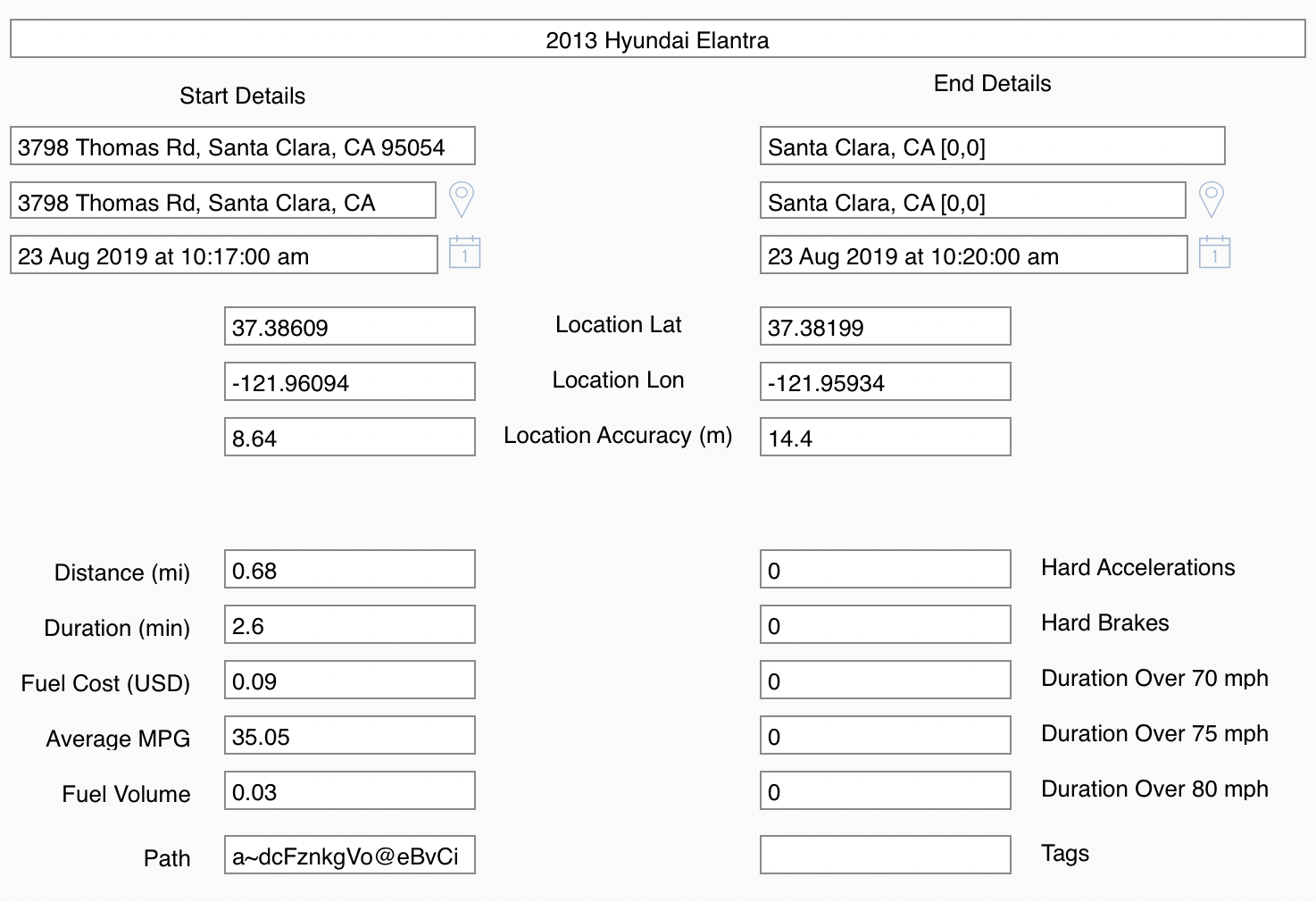
I went with an approach of splitting the start and end with their fields aligned at the top and the location fields immediately below it. This two panel style also naturally helps compact some of the other details. As you can see it sometimes doesn’t get the location fully detailed but the geo point generally gets it. In theory you can hook up API access to Automatic but I find you can export the data when you care about it. The JSON format has more data in it than what they export as CSV though but you can see it likely has what you need.
I’ve personally moved onto another OBD adapter that gives me a lot more low level detail but the Automatic adapter worked reasonably well for me for three years I was using it. They deprecated that Adapter and I chose to move on. The newer adapter gives me second level precision which is useful but creates really large log files. If you want a mostly turn key solution, Automatic is the way to go.
I’ve also attached my refueling log entries script. When I refuel my car, I write down the details from the car’s computer (trip distance, odo, estimated range (before and after refueling), MPG/MPH and drive time. Comes with a layout I use for side by side data entry. I use VueScan to do my initial import of the receipt which creates a new Tap Forms record I can transcribe the details from later.
Attachments:
You must be logged in to view attached files. -
AuthorSearch Results