


Search Results for 'script'
-
Search Results
-
Topic: Logger Module
As I’ve built field scripts, one of the challenges ended up being figuring out which field is running at which time when you have multiple fields and potentially multiple forms. Below is a logger module that I use to help me keep track with timestamps and headers. You can import this script and a few others by using my “Script Manager” form.
Here’s a sample output showing re-entrant behaviour (the script field triggered itself to run):
==================================================================
Start "Shipping/Delivery Autopropagate (Orders)" script execution at Sun Jul 21 2019 10:22:46 GMT-0700 (PDT)
==================================================================

Sun Jul 21 2019 10:22:46 GMT-0700 (PDT)	One shipment detected, validating shipment data
Sun Jul 21 2019 10:22:46 GMT-0700 (PDT)	shipping date set in shipment but not in order, updating order
==================================================================
Start "Shipping/Delivery Autopropagate (Orders)" script execution at Sun Jul 21 2019 10:22:46 GMT-0700 (PDT)
==================================================================

Sun Jul 21 2019 10:22:46 GMT-0700 (PDT)	One shipment detected, validating shipment data

==================================================================
End "Shipping/Delivery Autopropagate (Orders)" script execution at Sun Jul 21 2019 10:22:46 GMT-0700 (PDT)
==================================================================

==================================================================
End "Shipping/Delivery Autopropagate (Orders)" script execution at Sun Jul 21 2019 10:22:46 GMT-0700 (PDT)
==================================================================
Screenshot with less wrapping:

There are two parts that I find useful, the first is the separators which look like this:
logger.consoleHeader('Shipping/Delivery Autopropagate', 'Orders');
var result = propagateDates();
logger.consoleFooter('Shipping/Delivery Autopropagate', Orders');
result;
This creates the header and footer lines in the format you see in the example above. The other part is the
loggerlines:logger.logMessage("One shipment detected, validating shipment data");This then adds the timestamp and also stores the log messages temporarily.
Because I don’t want to copy and paste this all of the time, I have a form called “Script Manager” where I create form scripts that I put in like this (creatively called “Logger”). This means that I can import this with a single line when I want to use it:
document.getFormNamed('Script Manager').runScriptNamed('Logger');Here’s the module:
{ // ========== Logger Start ========== // // NAME: Logger // VERSION: 1.0.2 /** * Logger module provides some extra utility functions for logging data. * This adds some useful functions for integrating with the console and * for building script fields. */ if (logger == undefined) var logger = (function() { var logdata = ""; return { /** * Log a message * * Takes a <code>message</code> and adds it to the internal <code>logdata</code> variable * and also logs it to the console with a timestamp. */ logMessage: function(message) { logdata += message + "\r\n"; console.log(new Date() + '\t' + message) }, /** * Log an error * * Takes a <code>message</code> and <code>error</code> object and then formats into an error * via <code>logMessage</code>. */ logError: function(error) { this.logMessage(<code>Caught error: "${error}" at ${error.line}, ${error.column}</code>); }, /** * Get the internal log buffer * * Returns the raw log buffer to output elsewhere. */ getLog: function() { return logdata; }, /** * Clear the internal log buffer * * Resets the buffer to an empty string. */ clearLog: function() { logdata = ""; }, /** * Utility function to print a header when the script starts with optional form name */ consoleHeader: function(scriptName, formName = "") { var label = scriptName + (formName ? <code>(${formName})</code> : ''); console.log('=================================================================='); console.log('Start "' + label + '" script execution at ' + new Date()); console.log('==================================================================\n'); }, /** * Utility function to print a footer when the script ends with optional form name */ consoleFooter: function(scriptName, formName = "") { var label = scriptName + (formName ? <code>(${formName})</code> : ''); console.log('\n=================================================================='); console.log('End "' + label + '" script execution at ' + new Date()); console.log('==================================================================\n'); } } })(); } // ========== Logger End ========== //I have a form called “Order” where I store stuff I order online. It has a child record called “Shipments” which store shipments. I often want to quickly add a new shipping record and use this as a form script with the prompter to add in a new shipment record with the tracking ID and carrier set. It also will set the shipping date based on the order record if it’s already set or default it to the current date.
This uses the prompter for user interaction (including leveraging a pick list) and
addNewRecordToFieldfor adding a new record to a Link to Form field. It also demonstrates usingsetFieldValuesto bulk set values and also usesJSON.stringifyto dump out debugging information withconsole.log. Here’s a screenshot of the prompter: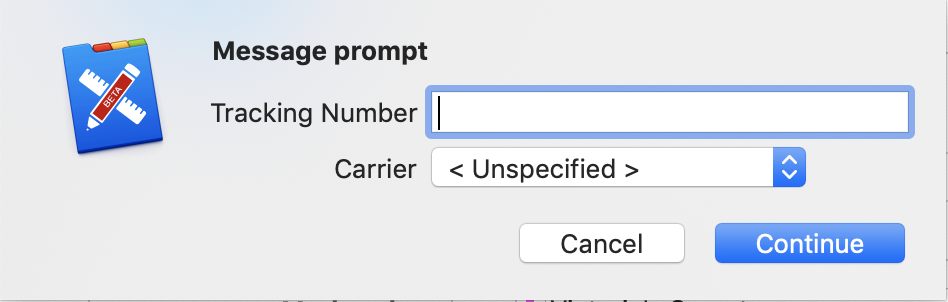
Field names are at the top, replace with ID’s matching your fields.
// Order: Shipment Field ID var shipments_id = 'fld-db2fcdb4d79c466ea09671c47d2ae645'; // Order: Ship Date var ship_date_id = 'fld-6ab700ccc11d418fbd27d8899d00c7a9'; var ship_date = record.getFieldValue(ship_date_id); // Shipments: Record Field ID's var tracking_number_id = 'fld-c487390743c947969cbe661cff596855'; var carrier_id = 'fld-0950c430cb0c41f79c51d43a544b366b'; var shipping_date_id = 'fld-1aa32f17e059424fb4e24bf894b34fdf'; var callbackFunction = function() { if (tracking_number && carrier) { var data = { [tracking_number_id]: tracking_number, [carrier_id]: carrier, }; if (ship_date) { data[shipping_date_id] = ship_date; } else { data[shipping_date_id] = new Date(); } console.log(JSON.stringify(data)); var shipmentRecord = record.addNewRecordToField(shipments_id); shipmentRecord.setFieldValues(data); document.saveAllChanges(); } }; let prompter = Prompter.new(); prompter.addParameter('Tracking Number', 'tracking_number', 'text') .addParameter('Carrier', 'carrier', 'picklist', 'Carrier - Shipments') .show('Message prompt', callbackFunction);Hey Everyone,
It was suggested to me that it would be a good idea to have a separate Scripting forum on my website.
Well, here it is.
This is the place to be if you want to post useful scripts to make Tap Forms do things you never thought possible.
If you’re unfamiliar with scripting in Tap Forms, please see the Scripting topics in the online user manual here:
https://www.tapforms.com/help-mac/5.3/en/topic/scripts
and the Tap Forms specific JavaScript API docs are here. These are the functions you can call within a Tap Forms script that do things specific to Tap Forms, such as fetching a set of records, reading field values, setting field values, and updating the database.
https://www.tapforms.com/help-mac/5.3/en/topic/javascript-api
It’ll be great to see what kinds of scripts you can come up with to make Tap Forms more powerful than ever.
Thanks!
Brendan
Forum: Script Talk
The place to be if you want to talk about Scripting in Tap Forms 5.Topic: Watched TV Shows Template
Hi Brendan,
Sorry if this is the wrong place to put this, but I am using the Watched TV Shows Template, which is exactly the thing I am looking for it’s just that the script doesn’t do anything, at least that is visible to me.
I have generated my api key and have pasted that in the script in TF.
Now when I run the script it asks for a IMDB URL which I paste in (example for The 100 would be https://www.imdb.com/title/tt2661044/ but then the script does not seem to do anything after that.Is there something I am missing.? The script console shows no messaged either. Any help would be appreciated.
Thanks
Andrew


